
Joe McWilliams
When I was 14 the McWs went off on what was the only family road trip vacation I think we ever took. It was a big one, starting in Hudson’s Hope, B.C., going to Prince Edward Island and back in time for school.
That was when the price of a tank of gas wouldn’t kill you, even at eight miles to the gallon, or whatever my dad’s Ford got. It was a comical scene, a little camper intended for a pickup truck perched on the back of the one-ton. Rolling across the country west to east, east to west, seeing Canada in all its vastness for the first time (the kids, at least).
One of the early stops on the trip was at, or near, Beechy, Saskatchewan. My dad had a couple of cousins there, Norbert and Cecil Bowman. Their mom Eunice (If I have this correctly) was a sister to his mother, my grandmother Nettie Bowman McWilliams
The Bowmans were spud islanders, like my dad. They’d come out to the prairies when… the 1920s? 1930s? They had a grain farm, in country so flat you could see your dog running away for three days, as the joke goes. It was very strange and kind of unsettling to us northern kids, used to being surrounded by trees, everywhere, all the time.
Norbert and Cecil. I remembered nothing about them but their names. I’m glad I did, because 30 (or so) years later, I was interviewing Bill Pearson about senior hockey. He was coaching the Slave Lake Winterhawks, the local senior men’s team. I had the idea to do a story about how much senior hockey had changed in recent decades, and I wanted to get Bill’s views on it.
Has it ever, he said, and started to tell me about how the very small community of Beechy had managed to sustain a competitive squad, back in the 1950s and 1960s. It was called the Beechy Bombers, and Bill played for the team as a young man.
‘Beechy?’ I said. ‘I have relatives there.’
It didn’t take long to figure out that he not only was familiar with my dad’s cousins, but knew them as part of the volunteer network that made senior hockey possible. In a town of not more than 300 people (243 and shrinking, as of 2016), it wouldn’t have worked without widespread community support. I’m pleased that my relatives were part of that.
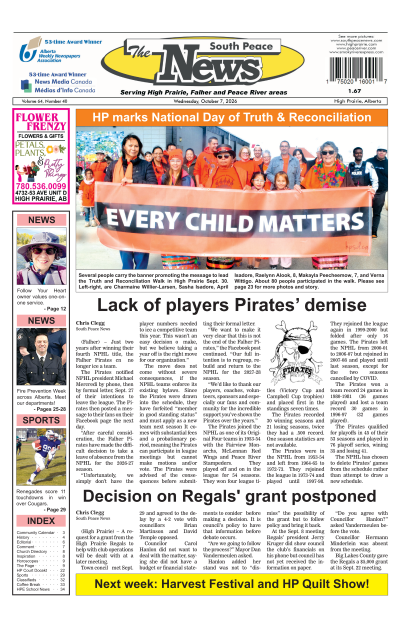
Getting back to Slave Lake, it seems absurd that a wealthy town of 7,000 people can’t figure out how to come up with and sustain a decent senior hockey program. But the times they are a changin,’ as Bob Dylan sang, 60 years or so ago.
One way things are changing is everyone is too busy to get involved and make something like senior hockey happen. What, exactly is keeping people so busy is kind of hard to figure out. We’ve got the same sort of human beings, in sufficient numbers.
What’s changed, I suppose, are interests and priorities. Lots of good things are happening, I don’t mean to suggest we’re in a total desert here. Where kids are concerned, for example, parents do get involved and create opportunities. That hasn’t changed all that much.
But senior hockey? Apparently it’s something we can do without. The same goes for senior baseball. It’s been a few years since any league existed in the Slave Lake area.
On the other hand, we hear pickleball is booming. I might have to look into it.









 Environment Canada Forecast
 Alberta 511 Road Reports
 Alberta Wildfire Status Map








0 Comments